

Most businesses want to expand their offerings, launch faster and compete with bigger players but hit the same wall: limited resources, high development costs and lack of in-house expertise.
The result? Missed opportunities, slow growth and the constant pressure of trying to do everything yourself while competitors move faster with broader services.
That is where white labeling changes the game. Instead of building from scratch, you leverage ready-made products or services, rebrand them as your own and go to market quickly without the heavy lifting.
In this guide, you’ll learn exactly what white labeling means, how it works, real-world examples and how to build a scalable white label business in 2026.
What Is White Labeling?
Before exploring the business mechanics, let’s start with a clear definition. White labeling is a concept that sounds complex on the surface but becomes intuitive once you see how the pieces fit together. Let us break it down from the ground up.
Simple Definition: White labeling is when a third-party provider creates a product or service, and a reseller purchases it, applies their own brand identity and sells it to their customers as if they made it themselves.
The original producer stays completely invisible to the end consumer.
Technical Definition: In business terminology, white labeling refers to a contractual arrangement between a manufacturer or service provider and a reseller. The provider creates a generic, market-ready product or service.
The reseller applies their own brand identity: name, logo, colors, packaging and distributes it through their own sales channels. The reseller controls the pricing, customer communication, and overall customer experience.
This model is used across industries ranging from SaaS to physical goods, from digital marketing services to financial products.
A Quick White Label Example: A digital marketing agency wants to offer SEO services but does not have an in-house SEO team. They partner with a white label SEO firm.
The SEO firm does the work; the agency presents the results to clients under their own brand. The client never knows that a third-party provider was involved.
What Is White Label in Business?
White labeling varies by industry, business scale, and what is being sold. To properly answer what white-labeling is in business, it is worth looking at who uses it, how the model is structured, and what has made it so appealing to companies of every size.
How Businesses Use White Labeling
Understanding what white-labeling in business is requires seeing it from both sides of the arrangement.
On one side, you have manufacturers or service providers who want additional revenue without investing in sales and marketing.
On the other side, you have resellers who want to expand their product catalog or service offering without investing in production.
Businesses adopt the white label business model in several distinct ways:
- Agencies add services like SEO, PPC, or web design to their portfolio by outsourcing delivery to a white label partner
- Ecommerce brands sell physical goods manufactured by a third-party supplier under their own brand name
- SaaS companies license their software platform to other businesses, who rebrand and resell it as their own tool
- Retailers stock products made by manufacturers, labeled with their own store brand
Key Components of the White Label Business Model
Every white label arrangement involves three core players:
- The Original Provider: The manufacturer, developer, or service firm that creates the core product or service
- The Reseller (Brand Owner): The business that licenses, purchases, or partners with the provider and applies its own branding
- The End Customer: The buyer who interacts only with the reseller’s brand and is typically unaware of the third-party involvement
Why the White Label Business Model Has Become So Popular
The modern marketplace rewards speed. Launching a product from scratch takes time, capital, and expertise that many businesses simply do not have. White labeling solves all three problems at once.
According to research cited by brizy.io, businesses with a clear growth plan grow 85% more than those without one, and the white-label model provides any business with a structured, low-risk way to scale.
Meanwhile, the global digital marketing industry, which is closely tied to white-label services, is growing at a CAGR of 13.1%, according to data from amraandelma.com.
How Does White Labeling Work?
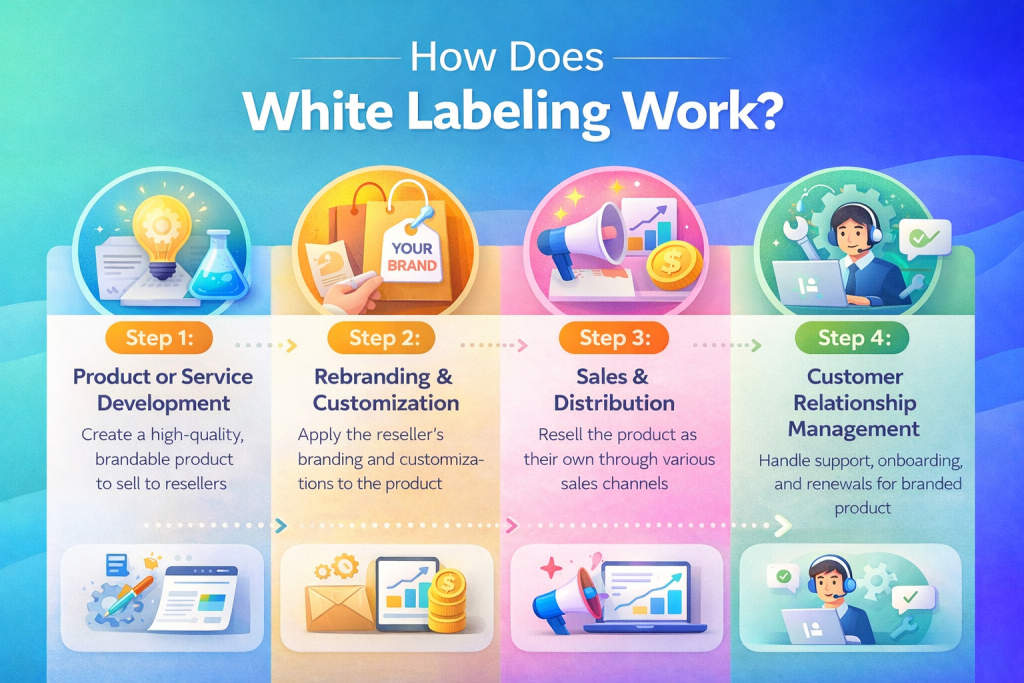
Understanding the white label meaning is one thing; seeing how it actually operates in practice is another.
The process follows a clear, repeatable sequence that works across industries from software to physical products to professional services.
Here is each stage broken down.
Step 1: Product or Service Development
The original provider, whether a software company, manufacturer, or service agency invests in creating a high-quality, market-ready product or service.
This offering is deliberately designed to be generic and brandable.
The provider handles all the R&D, quality assurance, infrastructure, and operational complexity so the reseller does not have to.
Step 2: Rebranding and Customization
The reseller selects the product and applies their brand identity to it.
This includes swapping out logos, updating color schemes, renaming the product, adjusting packaging, and aligning the look and feel with their brand guidelines.
In the case of SaaS white label platforms, this often extends to custom domain names, white-labeled dashboards, and even suppressed references to the original provider.
This is exactly what tools like Element Pack Pro enable WordPress agencies to do.
With its built-in White Label Branding feature, agencies can rebrand the entire Element Pack Pro plugin under their own name, removing all BdThemes references to ensure their clients see a seamless, branded experience.
Step 3: Sales and Distribution
The reseller markets and sells the rebranded product through their own channels: website, sales team, email list, or agency proposals.
They control pricing, positioning, and all customer-facing communication. The original provider remains in the background.
Step 4: Customer Relationship Management
The reseller owns the customer relationship entirely. They handle support inquiries, onboarding, account management, and renewals.
From the customer’s perspective, the reseller is the product company.
A Complete Workflow Example
To see how these steps connect in practice, consider this scenario. A boutique digital agency wants to offer website management and design support without expanding their team.
Here is how white labeling plays out:
- The agency licenses Element Pack Pro under its Agency plan, which includes white label branding
- They rebrand the plugin interface with their own agency logo and company name
- Using Element Pack’s 2,700+ ready-made templates and 300+ advanced widgets, they deliver premium website builds in a fraction of the usual time
- They leverage the Live Copy-Paste feature to instantly transfer design sections across client websites, with no rebuilding from scratch
- Clients receive a professional, branded experience and never see the original plugin’s identity
The agency scales its output, reduces costs, and builds its brand all without developing a single widget from scratch.
Real-Life White Label Examples
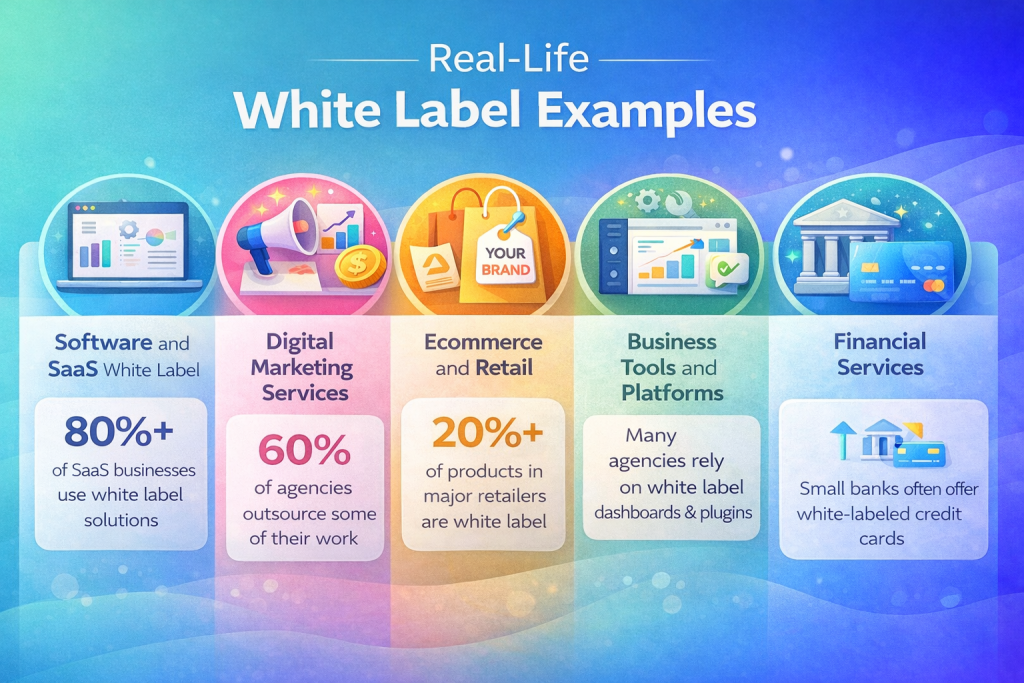
White label examples are everywhere once you know what to look for.
From the software tools agencies use daily to the products on supermarket shelves, the model cuts across industries in ways that are surprisingly easy to spot.
Here are the most common categories where white labeling shows up in the real world.
Software and SaaS White Label
The SaaS white label space is enormous.
According to projections cited by whitelabelwonder.com, the global SaaS market is expected to reach $908.21 billion by 2030, growing at a CAGR of 18.7%.
A huge portion of that growth is powered by white label SaaS arrangements.
Common SaaS white label examples include:
- Email marketing platforms that agencies resell under their own brand
- Website builders licensed to other businesses who offer them to their clients
- CRM systems white-labeled by consulting firms
- Elementor addon plugins like Element Pack Pro, used by agencies and freelancers to deliver advanced website functionality under their own branding
Digital Marketing Services
White label marketing services are perhaps the most common use case in the agency world.
A full-service agency can present clients with SEO, PPC, content marketing, social media management, and analytics, all delivered by specialist white label partners behind the scenes.
According to data from amraandelma.com, more than 60% of agencies rely on outsourcing to scale their PPC campaigns effectively.
Agencies that outsource 40 to 60% of their service delivery grow approximately 2.3 times faster than their peers and enjoy profit margins 18 to 22% higher.
For agencies building client websites on WordPress and Elementor, tools like Element Pack Pro serve as the perfect white label infrastructure.
You can explore the full capabilities in their widget library to understand how much functionality is available for rebranding.
Ecommerce and Retail
Walk into any major retailer and you will find white label products everywhere. Costco’s Kirkland Signature is one of the world’s most well-known examples. A brand applied to products manufactured by a range of third-party suppliers.
Amazon Basics operates on a similar principle.
In ecommerce, white label products allow brands to expand their catalog rapidly without managing production.
Coffee is a particularly visible example: many independent cafes, hotel chains, and online stores sell their branded coffee, when in reality the beans come from a white label coffee roaster.
For anyone building an ecommerce site with Elementor, see the best Elementor addons for WooCommerce to understand which tools can power white-labeled store experiences.
Business Tools and Platforms
Agencies delivering web design, branding, and digital strategy services increasingly rely on white-labeled tools to work at scale.
This might include white-labeled project management dashboards, reporting tools, or most relevantly for WordPress professionals: white-labeled page builder plugins.
Element Pack Pro’s Agency plan includes a White Label Branding feature that lets you transform the plugin into your own branded powerhouse.
No BdThemes footprint, no third-party references, just your identity in the client’s WordPress dashboard.
This is a textbook example of a white label product designed specifically to serve agencies operating a reseller business model.
Financial Srvices
Smaller banks sometimes outsource credit card or payment processing to larger institutions that issue and process cards as white-label products.
It allows the smaller bank to offer the service under its own brand without the infrastructure investment. As per Wikipedia’s entry on white-label products, this is a long-established practice in the financial sector.
Benefits of White Labeling
The benefits of white labeling explain why so many businesses across so many industries have made it a central part of their growth strategy.
Whether you are a solo freelancer or a growing agency, the advantages compound quickly once you commit to the model.
1. Faster Time to Market
Building a product from scratch developing features, testing, iterating, and finally launching can take months or even years.
White labeling collapses that timeline to days or weeks. The product already exists, already works, and is already proven in the market. Your only job is to brand it and sell it.
This speed advantage is especially critical in fast-moving markets like digital marketing, SaaS, and ecommerce, where being slow to launch can mean missing a window entirely.
2. Significantly Lower Costs
Traditional product development requires heavy investment in R&D, hiring specialists, infrastructure, and quality assurance.
White labeling removes all of those costs. You pay a licensing fee or wholesale price and keep the margin from your end-customer pricing.
As per data from amraandelma.com, white label marketing agencies enjoy profit margins 18 to 22% higher than agencies that try to build every capability in-house.
3. Scalability Without Proportional Overhead
One of the most powerful benefits of white labeling is the ability to scale revenue without proportionally scaling headcount or infrastructure.
A three-person agency can offer a suite of 10 services web design, SEO, PPC, content, social, analytics, and more by white labeling each one. They remain lean while their service catalog grows.
4. Brand Growth and Authority
Offering a broader range of high-quality services or products under your brand builds authority and customer trust.
Clients see a full-service provider, not a specialist with gaps. Over time, this expands your share of wallet per client and strengthens client retention.
5. Focus on Core Competencies
White labeling lets you do what you are best at whether that is sales, client relationships, or strategy while leaving production and delivery to specialists.
This division of focus leads to better outcomes on both ends of the partnership.
White Label vs Private Label: What’s the Difference?
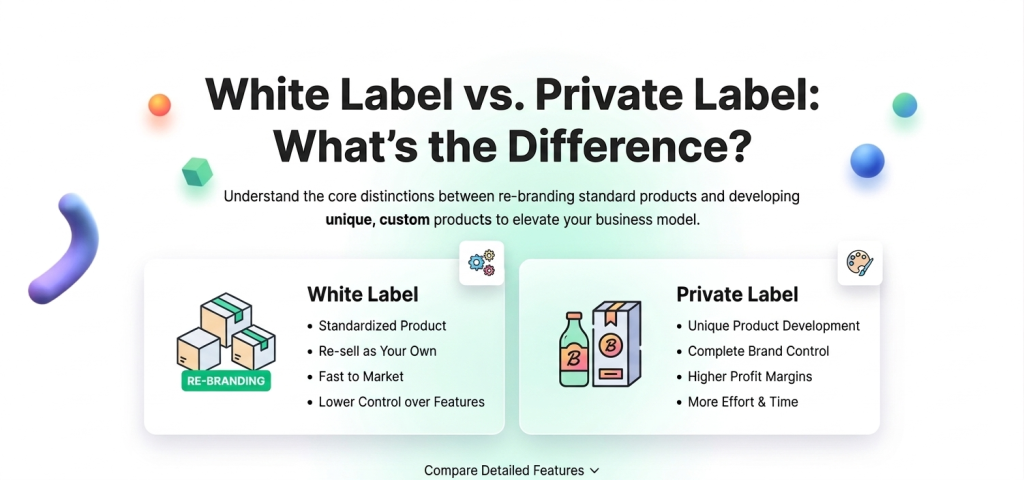
The white label vs private label difference comes down to exclusivity, customization depth, and who controls the product.
Understanding the distinction will help you choose the right model for your specific situation.
- White Label: A generic product or service produced by one company and sold to multiple resellers, each of whom applies their own branding. The core product is identical across all resellers only the label changes.
- Private Label: A product created exclusively for one retailer or brand, typically built to that brand’s specific requirements. The product is unique and not available to other resellers.
Side-by-Side Comparison
The table below captures the most important distinctions at a glance:
| Feature | White Label | Private Label |
|---|---|---|
| Product uniqueness | Same product, different branding | Custom-built for one brand |
| Exclusivity | Non-exclusive (multiple resellers) | Exclusive to one buyer |
| Customization depth | Branding only (logos, colors, naming) | Product specifications, formulas, features |
| Time to market | Very fast | Moderate to slow |
| Cost | Lower (shared production) | Higher (custom production) |
| Control over quality | Limited | Higher |
| Risk level | Low | Medium |
| Best for | Speed and scalability | Differentiation and exclusivity |
When to Choose White Label
White labeling is the right choice when your priority is speed, cost efficiency, and scalability.
If you want to launch a new revenue stream quickly adding SEO services to your agency, or expanding your ecommerce product range white labeling gives you a market-ready offering without the build time.
When to Choose Private Label
Private labeling makes sense when your brand needs a truly differentiated product one that your competitors cannot sell in identical form.
It requires more investment and time, but the resulting exclusivity can justify premium pricing and deeper brand loyalty.
For most digital agencies and SaaS resellers, the white label path offers a far better risk-to-reward ratio, especially when starting out.
Types of White Label Products and Services
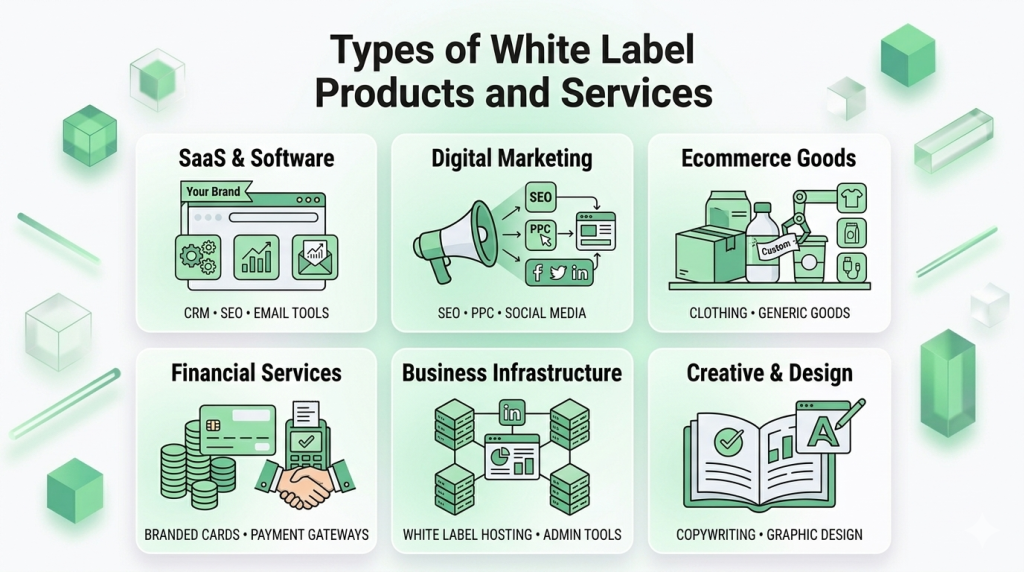
White labeling is not limited to one sector or product type.
The model has found a foothold in nearly every corner of the business world. Here is a look at the most prominent categories where white label products and services appear today.
Software as a Service (SaaS)
SaaS white label is one of the fastest-growing categories in the model. Agencies and platforms license SaaS tools and present them to clients as proprietary products.
This includes CRM systems, email marketing platforms, SEO reporting tools, website builders, and Elementor addon plugins.
The global SaaS market is on track to reach $908.21 billion by 2030, as per projections cited by whitelabelwonder.com.
Digital Marketing Services
White label marketing services include SEO, pay-per-click advertising, social media management, content creation, email marketing, and analytics.
These are commonly used by agencies that want to offer a full-service experience to clients. As per amraandelma.com, 80% of companies outsource at least one part of their marketing, making this one of the most normalized applications of the white label model.
If you are building agency websites to support these services, see the best WordPress page builders to find the right foundation for your client work.
Ecommerce Products
Physical goods are among the oldest white label examples.
Everything from grocery store generics to clothing, supplements, electronics accessories, pet products, and personal care items is manufactured by third-party suppliers and sold under various brand names.
As per NIQ’s Mid-Year Consumer Outlook data, 50% of global consumers report buying more private/white label products than ever before.
Financial and Business Services
Banks, fintech startups, and payment processors commonly white-label infrastructure from larger institutions.
This allows them to offer branded credit cards, banking accounts, payment gateways, or investment products without building the underlying technology.
Creative and Design Services
Graphic design, video production, copywriting, and web development are all frequently delivered as white label services.
A marketing agency might white-label a design studio’s work, presenting it to clients as their in-house team’s output.
How to Start a White Label Business
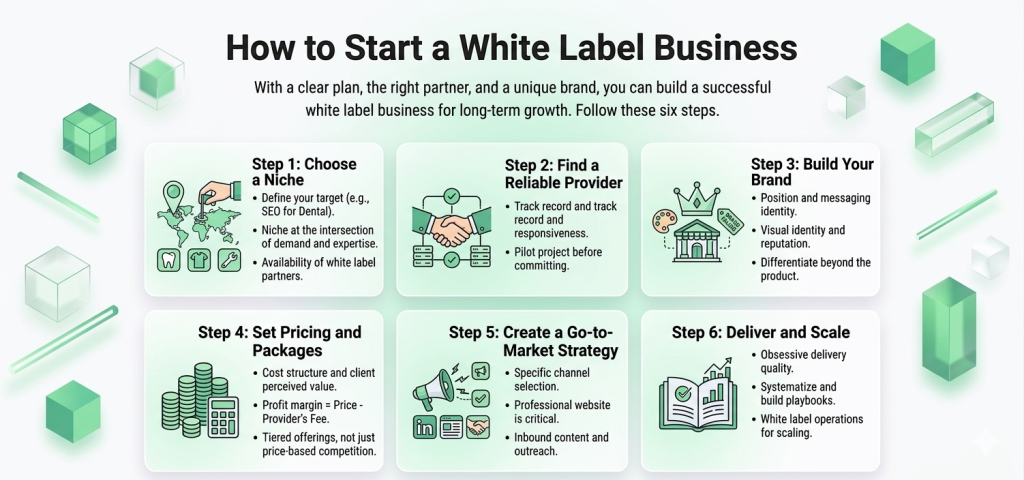
Getting into the white label business does not require a large budget or an experienced team.
What it does require is a clear plan, the right partner, and a brand that gives clients a reason to choose you. With these six steps you can build a white label business that is set up for long-term growth.
Step 1: Choose a Niche
Broad is not your friend in the early days.
The most successful white label businesses start with a clear niche a specific industry, service type, or customer segment. For example, instead of “digital marketing,” consider “SEO and web design for dental practices” or “ecommerce website management for fashion brands.”
Your niche should sit at the intersection of market demand, your existing expertise, and the availability of good white label partners.
Step 2: Find a Reliable Provider
Your white label business is only as strong as the provider behind it. Quality, consistency, responsiveness, and the provider’s willingness to stay invisible are all critical.
Vet potential partners by reviewing their track record, asking for case studies, and running a pilot project before committing.
For WordPress agencies, Element Pack Pro is a well-established option with 100,000+ active users, a 4.7/5 rating on WordPress.org, and a dedicated white label branding feature built specifically for agencies. You can review their pricing plans to find the right tier for your client volume.
Step 3: Build Your Brand
Your brand is the only thing distinguishing you in a white label business, since the core product is available to other resellers too. Invest in your positioning, messaging, visual identity, and reputation.
Define clearly what you stand for and who you serve.
For inspiration on building a distinct visual presence, these examples of sites built with Elementor show how design consistency and branding can elevate a business’s online presence.
Step 4: Set Pricing and Packages
Pricing a white label offering requires understanding your cost structure and the perceived value to your end customer.
Your cost is the provider’s fee; your price is what the client pays. The margin in between is your profit.
Common approaches include:
- Fixed monthly retainers for ongoing service delivery
- Project-based pricing for one-time deliverables
- Tiered packages (Basic, Professional, Enterprise) to capture different customer segments
Avoid the temptation to compete on price alone. Differentiate through service quality, specialization, and relationship depth.
Step 5: Create a Go-to-Market Strategy
How will you reach your target customers?
The most common channels for white label businesses include inbound content marketing, LinkedIn outreach, referral partnerships, and industry-specific communities. Pick two or three channels and go deep rather than spreading yourself thin.
Building a professional website is a critical first step. Learn how to create a custom blog layout for Elementor to establish your content marketing presence and attract inbound leads.
Step 6: Deliver and Scale
Once you have landed your first clients, focus obsessively on delivery quality. Your reputation is everything in a white label model, because the product itself can be replicated by any competitor.
The relationship, reliability, and communication you provide are your true differentiators.
One practical way agencies protect and build that reputation is by offering branded review management as a client service. Monitoring and responding to online reviews under your own agency name signals professionalism and keeps clients from churning to competitors who offer more. You can find out more about white-label reputation management software to see how agencies add this as a fully branded, revenue-generating service without building the underlying technology themselves.
As your client base grows, systematize your processes, build playbooks, and consider white labeling some of your own operations to free up capacity for higher-value work.
Pros and Cons of White Labeling
Like any business model, white labeling has genuine strengths and real limitations worth understanding before you commit. Here is an honest look at both sides of the equation.
Advantages
- Low barrier to entry: No manufacturing, development, or significant capital investment required
- Speed: Launch in days or weeks rather than months
- Reduced risk: You are selling a proven product with a demonstrated market
- Scalability: Add clients without proportionally increasing your team or infrastructure
- Margin potential: Agencies that embrace white labeling report margins 18 to 22% higher than peers, per amraandelma.com data
Disadvantages
- Limited production control: You cannot dictate how the product is made, updated, or changed
- Provider dependency: Downtime, quality drops, or a provider exiting the market can directly impact your business
- Differentiation challenges: Competing resellers may sell the same product at lower prices, putting pressure on your margins
- Brand risk: If the provider delivers poor quality and it reaches your client, your brand takes the hit
Who Should Use White Labeling?
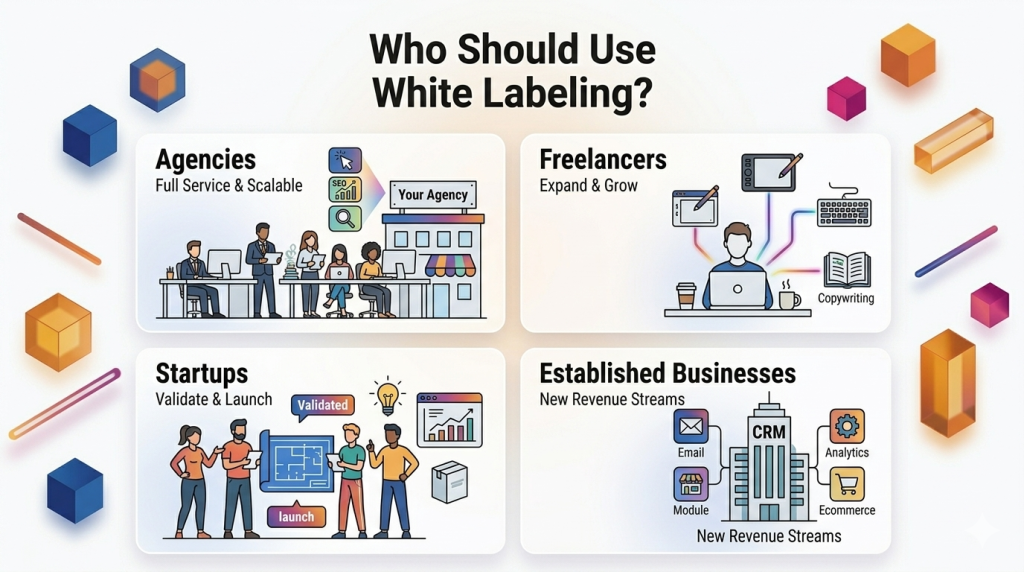
White labeling is a remarkably good fit for a wide range of business types. If any of the following profiles sound familiar, the white label business model is worth serious consideration.
Agencies
Agencies are perhaps the most natural fit for white labeling.
Whether you specialize in web design, digital marketing, or strategy consulting, the white label model lets you expand your service menu without expanding your headcount.
Offering SEO, PPC, or web development through white label partners means you can pitch as a full-service shop even as a lean team.
For web design agencies in particular, Element Pack Pro’s Agency plan with white label branding is designed precisely for this use case enabling you to deliver client websites with a branded tool suite that looks entirely like your own product.
Freelancers
Freelancers face a fundamental tension: clients want full-service solutions, but a solo operator can only do so much.
White labeling solves this by giving freelancers access to capabilities design, development, copywriting, ad management that would otherwise require hiring. You stay lean, stay profitable, and deliver more value.
Startups
Startups often need to test business ideas quickly and with minimal risk.
White labeling is an ideal model for validation: you can sell a white-labeled product or service to early customers, test market demand, and only invest in building proprietary capabilities once you have proven the concept.
Established Businesses
Large businesses use white labeling to add new revenue streams without the risk and distraction of building new product lines from scratch.
A company known for CRM software might white-label a complementary email marketing platform and offer it as an add-on, increasing customer lifetime value with minimal incremental effort.
White Labeling Trends in 2026
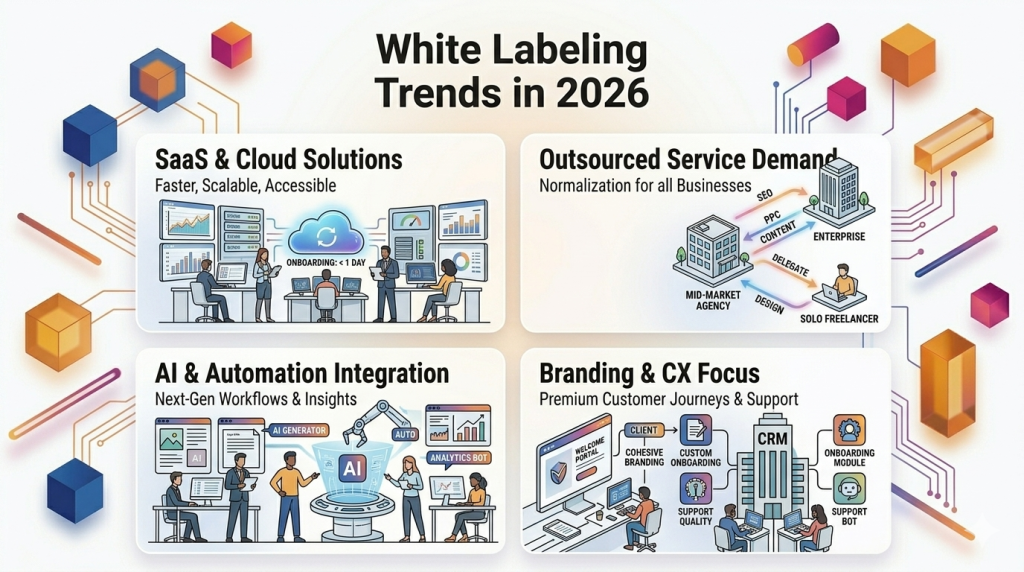
The white label landscape is shifting fast. Technology, changing buyer expectations, and the maturation of the agencies using these models are all reshaping what white labeling looks like and what it can deliver.
Here is what is defining the space in 2026.
Growth of SaaS-Based White Label Solutions
The transition to cloud-based software has made white labeling faster, cheaper, and more accessible than ever.
SaaS white label agreements now require no physical inventory, no shipping logistics, and minimal technical setup. Providers can onboard new resellers in hours, and resellers can be operational within a day.
Increasing Demand for Outsourced Services
As per data from amraandelma.com, 80% of companies outsource at least one marketing function.
This normalization of outsourcing continues to drive demand for white label services at every level of the market from solo freelancers to mid-market agencies to enterprise consulting firms.
Integration with AI and Automation
AI is reshaping white label services in 2026. White-labeled AI writing tools, design generators, analytics platforms, and customer service bots are becoming standard offerings in agency stacks.
The businesses that will win are those that white-label the best AI infrastructure and layer their own expertise and positioning on top.
Heightened Focus on Branding and Customer Experience
As the number of white label resellers grows, differentiation is increasingly about brand experience rather than the underlying product.
Resellers that invest in their own brand identity, customer onboarding, and support quality will capture and retain clients more effectively than those who compete only on price.
Tools that support deep white label branding like Element Pack Pro’s White Label Branding feature become increasingly valuable in this environment, as they allow agencies to present a fully cohesive branded experience across every touchpoint.
Conclusion
White labeling is one of the most powerful and practical business models available to agencies, freelancers, startups, and established companies alike. It removes the barriers of production, accelerates time to market, reduces risk, and makes scaling genuinely accessible whether you are a one-person consultancy or a growing digital agency.
Understanding the white labeling definition is just the starting point. The real opportunity lies in identifying the right products and services to white-label, partnering with providers who share your quality standards, and investing enough in your own brand to rise above the competition.
For WordPress professionals and digital agencies in particular, tools like Element Pack Pro offer a concrete, battle-tested example of the white label model in action a SaaS platform you can brand as your own and deploy across hundreds of client websites without starting from zero.
Frequently Asked Questions
What is white labeling in simple terms?
White labeling is when a company buys a product or service made by someone else and sells it under their own brand name. The manufacturer stays invisible, and the reseller takes full ownership of the customer relationship.
Is white labeling legal?
Yes, white labeling is completely legal. It operates on a contractual agreement between the provider and the reseller. Both parties agree to the arrangement, and end customers receive a legitimate product just branded by the reseller rather than the original manufacturer.
Is white labeling profitable?
White labeling can be highly profitable. The key is buying at the right price and selling with enough margin to cover your costs and generate profit. According to data from amraandelma.com, agencies that use white label services enjoy margins 18 to 22% higher than those that try to build all capabilities in-house.
What is the difference between white label and reseller?
A reseller typically sells a product under the original brand name they are more of a distributor. A white label reseller goes one step further: they rebrand the product entirely and present it to customers as their own offering. The white label model involves more brand ownership and customer relationship control than a standard reseller arrangement.
Can small businesses use white labeling?
Absolutely. White labeling is arguably most beneficial for small businesses, because it removes the need for large capital investments in product development. A solo freelancer can offer a full-service agency experience by white-labeling the right combination of tools and services, and grow from there without building an expensive in-house team.
Supreakshya Shrestha
The BdThemes team builds WordPress plugins trusted by 3M+ users worldwide. We write about web accessibility, WCAG compliance, and inclusive design.